
March 2, 2026
Intro
In many organisations, the greatest challenge is not defining the strategy.
It is implementing it.
The consulting industry has long separated the two, presenting strategy as the intellectual work and execution as the operational phase that follows.
In practice, this division creates a gap.
Insights remain conceptual. Execution becomes disconnected.
Organisations end up with strong ideas that do not translate into action.
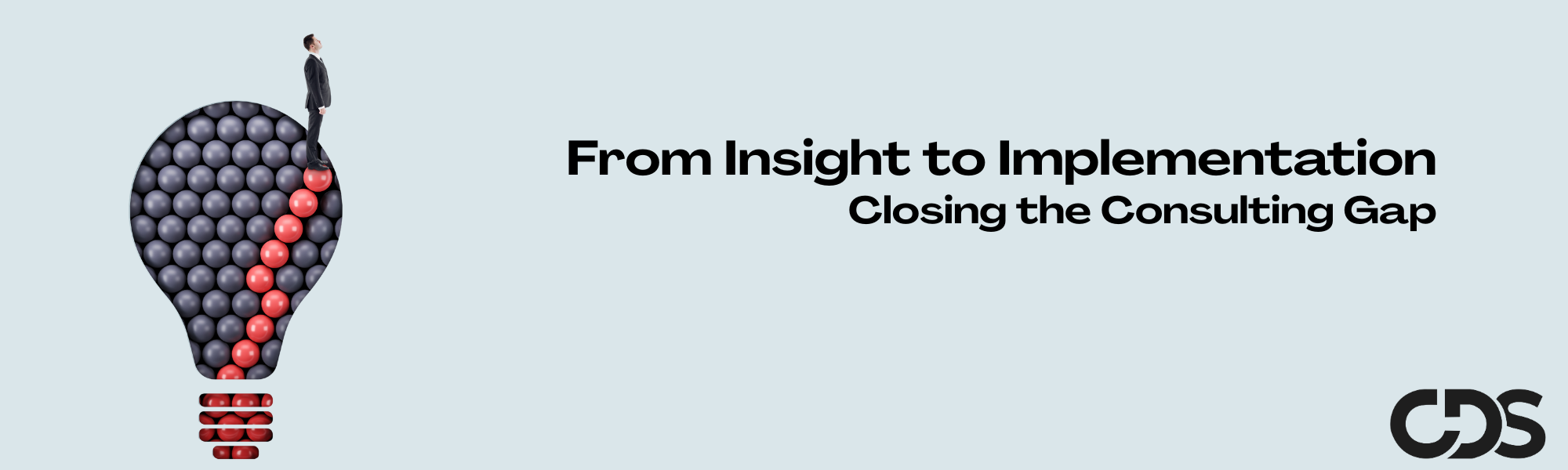
At CDS, we close this gap by treating strategy and implementation as one continuous process.
Insight without execution has limited value.
Execution without insight lacks direction.
The strength lies in the integration.
1. Insight Is Only the First Step
A strategy that cannot be applied is not a strategy. It is an intention.
Insights are valuable only when they can be translated into decisions, behaviours and processes that the organisation can adopt.
We design insights with the end state in mind.
Every recommendation is evaluated through three lenses:
• operational feasibility
• organisational readiness
• clarity of ownership
This ensures ideas move beyond the conceptual stage and into practical territory, stretching teams where needed without pushing them past what they can sustain.
2. Implementation Requires the Same Discipline as Strategy
Execution is often treated as a downstream activity.
In reality, it requires the same analytical rigour as strategy design.
Successful implementation depends on:
• precise sequencing
• alignment of roles and decision rights
• clear accountability
• realistic timelines
• structured support
CDS builds implementation models that reduce ambiguity.
This prevents loss of momentum and protects the integrity of the strategy.
3. The Missing Element in Most Strategies: Translation
Between knowing what to do and knowing how to do it, there is translation.
This is where many strategies lose traction.
Translation requires converting all decisions into:
• concrete steps and milestones
• actions by team and function
• measurable indicators
• routines that embed the change
At CDS, translation is not a handover.
It is an active phase in which we work with teams to shape a roadmap they can own and execute.
4. Strategy Fails When People Cannot See Themselves in It
Implementation is not a technical process.
It is a human one. Teams need to connect the strategy to their daily work and responsibilities.
This requires clarity on three questions:
What changes for me?
What am I responsible for?
How will success be measured?
We work with leadership and teams to build this clarity early.
It reduces resistance and accelerates alignment.
5. Integration Reduces Risk and Increases Speed
When strategy and implementation are designed together, organisations make faster and more confident progress.
Misalignment is reduced. Rework is avoided.
Leadership gains visibility on what needs to happen, by whom and by when.
Integration is not an additional layer.
It is the structural element that ensures the strategy remains intact as it moves through the organisation.
6. The CDS Approach: Insight Carried into Action
Our approach is built on a simple principle:
A strategy is only as strong as its ability to be executed.
This is why our consulting model integrates:
insight generation
organisational translation
decision architecture
implementation structure
ongoing alignment support
ongoing leadership involvement
The result is not a strategy on paper, but a strategy that moves through the organisation with clarity and purpose.
Conclusion
The gap between insight and implementation is where many strategies stall. Closing this gap requires an analytical approach that treats both sides of the work with equal importance and designs them as one system. At CDS, integration is not an additional step. It is the centre of our consulting practice. We ensure strategies are not only understood but delivered, not only designed but adopted.
And when this alignment is achieved, something else becomes possible. Organisations gain the confidence to move beyond compliance and into commitment. This is where passion starts to play a role. When clients see the energy and belief we bring to implementation and begin to share it, the work takes on a different momentum. Engagement increases, ownership strengthens and the organisation begins to carry the solution forward with its own conviction.
Passion cannot replace discipline, but when both are present, the impact becomes stronger and more sustainable. This is the shift that turns insight into true organisational performance.
FIND OUT MORE

March 20, 2025
Quiet Excellence: What 30 Years of Consulting Teaches About Consistency
Why lasting visibility is built through quality of work, not volume of noise.

March 20, 2025
The Art of Context: Why Regional Understanding Beats Global Templates
How deep regional understanding leads to strategies that work in practice, not just on paper.

March 20, 2025